
Download Preserving Food without Freezing or Canning: Traditional Techniques Using Salt, Oil, Sugar, Alcohol, Vinegar, Drying, Cold Storage, and Lactic Fermentation
- kaitlinwoodiethereseabram
-
 Minggu, 29 Maret 2015
 -
 0 Comments


Download Preserving Food without Freezing or Canning: Traditional Techniques Using Salt, Oil, Sugar, Alcohol, Vinegar, Drying, Cold Storage, and Lactic Fermentation
Preserving Food Without Freezing Or Canning: Traditional Techniques Using Salt, Oil, Sugar, Alcohol, Vinegar, Drying, Cold Storage, And Lactic Fermentation When composing can transform your life, when composing can improve you by offering much money, why don't you try it? Are you still extremely baffled of where getting the ideas? Do you still have no idea with exactly what you are going to create? Now, you will certainly need reading Preserving Food Without Freezing Or Canning: Traditional Techniques Using Salt, Oil, Sugar, Alcohol, Vinegar, Drying, Cold Storage, And Lactic Fermentation A good author is a great user simultaneously. You can define exactly how you write relying on just what books to read. This Preserving Food Without Freezing Or Canning: Traditional Techniques Using Salt, Oil, Sugar, Alcohol, Vinegar, Drying, Cold Storage, And Lactic Fermentation can assist you to resolve the issue. It can be among the right sources to establish your creating ability.
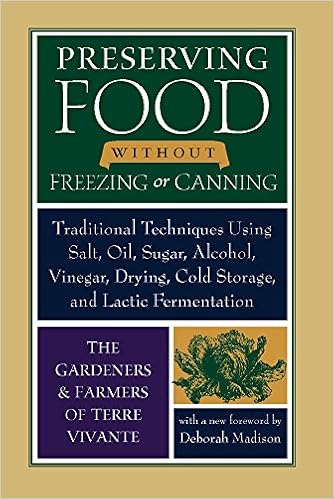
Preserving Food without Freezing or Canning: Traditional Techniques Using Salt, Oil, Sugar, Alcohol, Vinegar, Drying, Cold Storage, and Lactic Fermentation

Download Preserving Food without Freezing or Canning: Traditional Techniques Using Salt, Oil, Sugar, Alcohol, Vinegar, Drying, Cold Storage, and Lactic Fermentation
If you have been able right here, it implies that you have the ability to type and link to the web. Again, It implies that net turns into one of the solution that can make convenience of your life. One that you can do now in this collection is additionally one part of your initiative to improve the life high quality. Yeah, this website currently supplies the Preserving Food Without Freezing Or Canning: Traditional Techniques Using Salt, Oil, Sugar, Alcohol, Vinegar, Drying, Cold Storage, And Lactic Fermentation as one of products to review in this recent period.
The initial factor of why selecting this book is because it's provided in soft documents. It indicates that you could save it not only in one device yet likewise bring it almost everywhere. Preserving Food Without Freezing Or Canning: Traditional Techniques Using Salt, Oil, Sugar, Alcohol, Vinegar, Drying, Cold Storage, And Lactic Fermentation will certainly include exactly how deep guide will offer for you. It will certainly provide you something brand-new. Also this is just a publication; the existence will actually demonstrate how you take the ideas. And now, when you actually need to make take care of this publication, you can begin to get it.
The soft file indicates that you have to go to the web link for downloading and install and afterwards save Preserving Food Without Freezing Or Canning: Traditional Techniques Using Salt, Oil, Sugar, Alcohol, Vinegar, Drying, Cold Storage, And Lactic Fermentation You have owned the book to check out, you have actually postured this Preserving Food Without Freezing Or Canning: Traditional Techniques Using Salt, Oil, Sugar, Alcohol, Vinegar, Drying, Cold Storage, And Lactic Fermentation It is simple as visiting guide shops, is it? After getting this quick explanation, with any luck you can download and install one and also start to check out Preserving Food Without Freezing Or Canning: Traditional Techniques Using Salt, Oil, Sugar, Alcohol, Vinegar, Drying, Cold Storage, And Lactic Fermentation This book is quite easy to read every single time you have the leisure time.
Currently, when you need a brand-new good friend to accompany you facing and addressing the difficulties, Preserving Food Without Freezing Or Canning: Traditional Techniques Using Salt, Oil, Sugar, Alcohol, Vinegar, Drying, Cold Storage, And Lactic Fermentation is the prospect to advise. It can accompany you anywhere you go ad you require. It's developed for soft documents, so you will not feel hard to find and open it. Juts open up the tab and then review it. In this manner can be done naturally after you are getting the records by means of this website. So, your work is by clicking the link of that publication to go to.
About the Author
Deborah Madison is a freelance writer and board member of the Foundation for Bio-Diversity and the Seed Savers Exchange, among others. As a freelance writer she has contributed to Cooking Light, Williams Sonoma's Taste, Vegetarian Times, Gourmet, Food and Wine, Bon Appetit, Garden Design, Fine Cooking, Organic Style, the LA Times, Orion, and others.
Read more
Product details
Paperback: 224 pages
Publisher: Chelsea Green Publishing; New edition edition (April 4, 2007)
Language: English
ISBN-10: 1933392592
ISBN-13: 978-1933392592
Product Dimensions:
6 x 0.7 x 9 inches
Shipping Weight: 12 ounces (View shipping rates and policies)
Average Customer Review:
4.3 out of 5 stars
190 customer reviews
Amazon Best Sellers Rank:
#83,740 in Books (See Top 100 in Books)
I write and teach self-reliant, sustainable living. I've preserved my garden produce for decades. Since I discovered this book 5 yrs ago, it has consistently been in my Top Ten books you should have. This book teaches how to preserve almost every food you can grow without canning or freezing. For years my favorite go-to book on food preservation has been Stocking Up: The Third Edition of America's Classic Preserving Guide But this book goes into topics not covered in most food-preservation books. The key to good self-reliance and sustainability is to have a wide range of options, in case one crop fails or another overwhelms your freezer or pantry capacity. This book gives you that variety and weaves it into a complete, sustainable Whole.The chapters on Root Cellaring and Drying are not as detailed as some might like, but there are dozens of books on those topics and anyone that has gardened or homesteaded for any time is very familiar with these techniques.Where the book really shines is in the chapters on the lesser-known (and ages old) techniques of brining, lacto-fermentation and preserving in solutions such as oil, vinegar and alcohol. I attended a class on brining and lacto-fermentation where we were given taste samples of the brined and fermented food. The taste, color and texture are stunning! After tasting brined green beans--bright, crisp and still tasting garden fresh after 4 years in a jar--I could never go back to colorless, tasteless, soggy home-canned green beans. Family and friends go nuts over my sauerkraut and mixed vegetables brined one jar at a time. (It was this class that led me to this book.) I love that I can use non-canning jars with this process. This saves me on my food budget, keeps more out of the landfill and I don't have to worry about getting valuable jars back when I give the food away.One reviewer worried about the lack of food safety in these methods. No need to worry. These are ages-old techniques, used for centuries before home canning was ever thought of. They do not create the anaerobic environment that botulism thrives in. If one uses good-sense--wash your hands and clean all work surfaces and start with clean, sterilized equipment and jars--these methods are every bit as safe as any other food preservation.This is one of very few books that get my complete, unreserved endorsement. Trust me, you WANT this in your home library. [...]
I thought this book had a lot of information that I have never seen in print before. It makes a very nice addition to my library. I am sure that many of the recipes have been passed down from generation to generation. I plan to try some of them. However, I have been through the UC Master Food Preserver training courses and I would suggest that anyone thinking of using the recipes in this book contact their local Cooperative Extension to ask for information about how to guarantee the safety of the food they are preserving.
First off, others have complained about how "unsafe" this book is in terms of using the methods contained therein. That is hogwash. This book states several times that while they are doing things that the USDA deems "unsafe", these are practices that have been used for centuries and if done correctly, with common sense and clean supplies will not harm you. It also says in these instances to USE YOUR BEST JUDGEMENT. If you can't do that then you should probably not be preserving anything in any way at home. That point being done with, this is a wonderful book for those of us wanting to find alternatives to the classic home canning methods of food preservation and is also just plain a pleasurable read! My only problem is that a few of the method descriptions are a bit vague, such as "top the jar off with a few blueberries from last season". What if I don't have any from last season? But on the whole those are few & far between. And considering these are methods sent in to the author from people who are volunteering to part with family secrets & old world methods, often writing them down for the very first time in submitting them, it's not really surprising. But with a little further research these questions can be answered. Once again, if you're not willing to do a little more work and research to do things the old way then stick with store bought or rely on the modern canning company books to hold your hand.
I found this book to be very enlightning and useful as well. I was using one method already but with some trepidation. the contributors gave me useful insights and helpful tips which gave me confidence to experiment. Each week I make several jars of lacto fermented veggies and they are absolutely delicious! I'm delighted with the results and I'm happy to be able to not only preserve my produce but actually add to the nutritional value, when I can. When harvest time arrives, I will be happy to employ a couple of other methods. I like this book!
I like the book and have read it through. There are some good recipes but mostly the vegetables and dishes are from a very French perspective. Living in the South I don't need a great deal of information on artichokes, chicory, endive, cardoons, angelica, and so on. With that said, I enjoyed the book and reading and it will be useful. However, it will not be my first go to book for preserving.Oh, and she does use canning techniques just not 'pressure' canning. So there are recipes for jams, preserves, pickles and the like that are canned. In fact one I did use somewhat after a few changes was the Apple with Raisin Jam. I had never thought of adding a vanilla bean to the pot luckily I have them on hand.As I said, a good book but not a first go to for storing up or stocking the pantries, I would say a second go to and well worth having. If you don't have any experience this might not be a good starting point.
Preserving Food without Freezing or Canning: Traditional Techniques Using Salt, Oil, Sugar, Alcohol, Vinegar, Drying, Cold Storage, and Lactic Fermentation PDF
Preserving Food without Freezing or Canning: Traditional Techniques Using Salt, Oil, Sugar, Alcohol, Vinegar, Drying, Cold Storage, and Lactic Fermentation EPub
Preserving Food without Freezing or Canning: Traditional Techniques Using Salt, Oil, Sugar, Alcohol, Vinegar, Drying, Cold Storage, and Lactic Fermentation Doc
Preserving Food without Freezing or Canning: Traditional Techniques Using Salt, Oil, Sugar, Alcohol, Vinegar, Drying, Cold Storage, and Lactic Fermentation iBooks
Preserving Food without Freezing or Canning: Traditional Techniques Using Salt, Oil, Sugar, Alcohol, Vinegar, Drying, Cold Storage, and Lactic Fermentation rtf
Preserving Food without Freezing or Canning: Traditional Techniques Using Salt, Oil, Sugar, Alcohol, Vinegar, Drying, Cold Storage, and Lactic Fermentation Mobipocket
Preserving Food without Freezing or Canning: Traditional Techniques Using Salt, Oil, Sugar, Alcohol, Vinegar, Drying, Cold Storage, and Lactic Fermentation Kindle


0 komentar: